
Get to know Gilbert Balinda
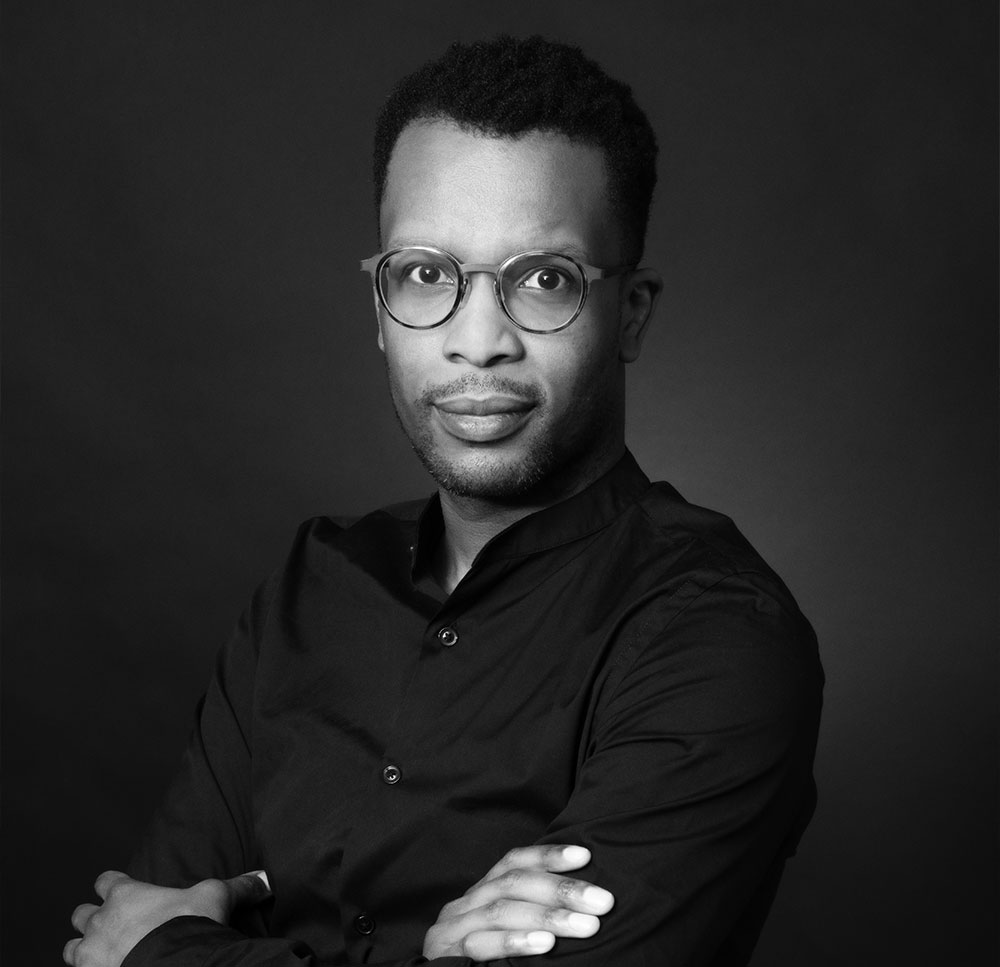
Gilbert Balinda is a Rwandan-Belgian architect, educator and critic within an acclaimed career spanning Africa, Europe, the Caribbean and Middle East.

Founder and Lead Architect
Gilbert Balinda’s history is one that spans the vastly divergent cultural influences of East Africa and Europe, with the 1994 Rwandan genocide serving as the catalytic bridge between his childhood in Kenya, Tanzania and Rwanda, and his family’s eventual asylum in Belgium. In Brussels, Balinda studied at the College St Michel before completing his Bachelor’s and Master’s degree at the Institut Supérieur d’Architecture St-Luc de Bruxelles, graduating magna cum laude in 2005 and cum laude in 2007 respectively.
He embarked on his professional career in South Africa, where he worked with celebrated architectural firm Mashabane Rose Associates until 2015 before co-founding Johannesburg- based interior-architectural studio Laterale with fellow St-Luc graduate Timothy Vandenbroeke.
From 2017 onwards, he served as heritage specialist and head of architectural design on such lauded South African cultural and civic projects as Freedom Park in Tshwane
World Architectural Festival Winner with MRA), the Taung World Heritage Centre, the Nelson Mandela Capture Site and Mandela Exhibition at the Apartheid Museum in Johannesburg.
Balinda is a regular visiting lecturer and critic at the University of Witwatersrand, the University of Johannesburg and the University of Pretoria. He is also an associate at ReWorx, an international firm that provides full assistance in decommissioning, remediation, adaptive reuse, and urban/land regeneration projects in both the civil and industrial sectors.
Balinda’s formative exposure to contrasting socio-political circumstances and cultural conditions has afforded him a unique and powerful perspective on diversity, context and the nature of collective and individual memory. This in turn ideally positions him to engage with the complexities and challenges of architecture and placemaking in the 21st Century.
Beyond aesthetic and technical responsibilities, we see our role as that of a cultural custodian and changemaker.
Our Philosophy
We believe in architecture as a profoundly human-centric endeavour
Beyond the technical and aesthetic responsibilities of an architect, we see our role as that of a changemaker and custodian – representing the interests and identity of people, understanding how place forms an intimate part of their social, emotional and environmental wellbeing, and finding ways to positively shape collective memory and experience. This philosophy of stewardship is at the core of everything we do, supported by an ethos of diversity and a belief in the power of partnership. Through Substantiae, our sibling research and idea incubation workshop, we encourage open discourse and speculative creativity to inform our architectural solutions.
Our approach
We undertake all our work, irrespective of scale or sector, in the pursuit of value creation.
Efficiency
We approach efficiency in architectural design by leveraging performance, be it functionality, accessibility, quality, comfort or aesthetics; against waste, whether in the form of cost, time, resources or energy. We understand that all design, particularly within the built environment, represents an exchange of gain and loss, and that our most significant responsibility lies in the improvement of place over time, and the dilution or elimination of harm to the environment, economy and humanity.
Impact
Beyond functional and formal benefits, we see architecture as an articulation of human values and beliefs – a reflection of how people see themselves, a demonstration of their relationship with one another and their environment, and an expression of what ideas hold currency at a particular point in time. With the understanding that our work will long outlive us, we strive towards architecture that will not only retain relevance for successive generations, but meaningfully contribute to the future of design discourse.
Sustainability
Responsible architecture begins with a holistic and long-term consideration of the ecosystem in which the structure or space will exist which, critically, includes the social, economic and environmental needs of those who will inhabit it in the future. In doing so, we consider the total lifespan of the design – the effect on existing communities, the degree of displacement of natural resources that will be required to realise the project, what technologies could offset potential negative environmental impacts.
Gilbert Balinda is a cutting-edge architectural practice with a commitment to reimagining a culturally complex and rapidly changing world through iconic, sustainable, and innovative design.
Services
Get us to call you back
Our team is experienced and dedicated to providing quality services, so you can be sure that you're in good hands. Contact us today to get started!
© 2022 Gilbert Balinda. All Rights Reserved | Website Design by Electric Sheep Agency.